Cloud VPN vs. consumer VPN: choose the right architecture
Private access or a different internet exit? Map your traffic path before choosing a VPN.
Read the guideStart with the path. Not the promise.
Understand cloud VPN architectures, choose a route scope, and build an access plan you can explain.
Conceptual flow. Actual routes and permissions depend on your deployment.
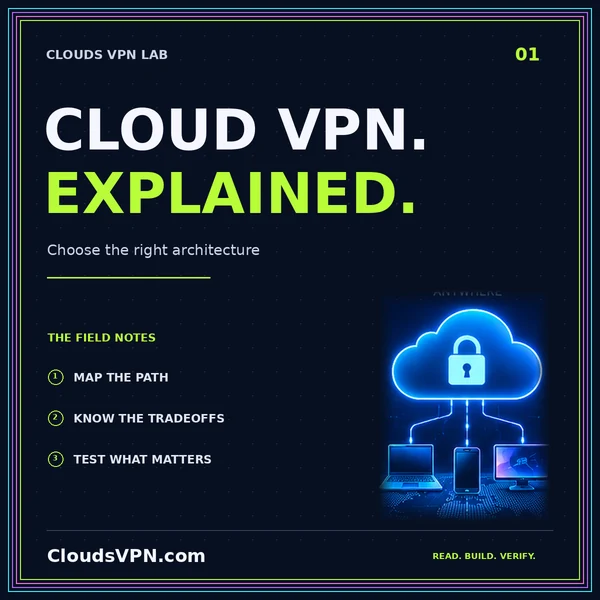
A cloud VPN is an encrypted network connection with an endpoint in cloud infrastructure. Depending on its design, it can connect an individual device to private resources, join two networks, or provide an internet exit. Those are different jobs, with different permission and privacy boundaries.
Connect individually enrolled devices to selected internal resources. Decide who may join, which destinations they need, and how to remove a lost device. Keep application authentication in place after the tunnel admits the connection.
Join networks through gateways when the requirement concerns a branch, office, or another environment. Plan nonoverlapping addresses, route ownership, return paths, and recovery. Reaching one network does not imply permission to every connected service.
Route selected internet traffic through an exit. Identify who operates that exit and what remains observable. Account logins, endpoint behavior, and application data handling remain relevant even when the destination sees a different public address.
An encrypted tunnel is not a guarantee of anonymity, faster internet, or secure applications. Choose it for a specific network requirement.
Private access or a different internet exit? Map your traffic path before choosing a VPN.
Read the guideA practical plan for server selection, peer identities, routing, operating costs, and recovery.
Read the guideNot necessarily. Cloud VPN often describes access to private infrastructure; consumer VPN commonly describes internet egress through a provider. The traffic path matters more than the label.
No universal setting fits every workload. Use the scope that satisfies your goal and test the actual device behavior, including DNS and IPv6.
Read the architecture comparison, write a one-sentence access requirement, and test one device reaching one nonproduction destination.